“Grande es el imperio que nos efrentamos. Pero más grande es nuestro
derecho de ser libres” – Don Pedro Albizu Campos
On Palm Sunday, March 21st, 1937, nearly 300 Puerto Ricans marched peacefully in the streets of Ponce, Puerto Rico. They had done it in all the right ways, securing parade permits. A peaceful march and protest. It was not only to celebrate Palm Sunday—but to also commemorate the abolishment of slavery, along with peacefully protesting the arrest of Don Pedro Albizu Campos “El Maestro”. Don Pedro was the president of The Nationalist Party in Puerto Rico. He was fighting for independence and freedom from imperialism/colonization and to break the chains the USA had/has on Puerto Rico and its people.
On this day Nationalist Cadets lined up in formation and marched while civilians celebrated and socialized with each other. Women, children, and the elderly all filled the beautiful streets of Ponce. Their laughter, and joy contagious. There was sudden cheering from bystanders as eighty cadets, twelve nurses in uniform, and a small marching band joined the march in support of the Republic of Puerto Rico. Palms were being waved, as the crowd smiled, rejoicing.
Then, the mayor of Ponce, José Tormos Diego, and the Insular Police Captain Guillermo Soldevilla showed up and began shouting at everyone to leave, that the parade was over. As of that moment, on the governors orders their permit was revoked. A few of the Nationalist debated heavily with these men. Behind them, over 200 police officers and two more captains stood, awaiting further instruction. They had brought a cavalry, ordered to stop the parade by any means. Carrying Thompson submachine guns, pistols, tear gas, and rifles. Ready for a battle.
Cadet leader Tomás López de Victoria turned around and ordered their marching band to play “La Boriqueña”, Puerto Rico’s national anthem. Tómas started marching and the others followed suit, ignoring the mayor and captains orders. The Cadets marched and all the bystanders started to sing along, marching down their street.
Then the sharp crack of a gunshot tore through the air. Iván Rodriguez Figueras buckled and dropped. The bullet hit his throat, and as his heartbeat slowly faded, blood squirt from the wound. Spraying a little girl who was standing next to him, causing her and others to scream.
Once more, a shot cracks through the air. As Juan Torres Gregory, just an eighteen year old boy who was watching the parade eagerly through his window, falls to the ground below seconds later—dead. An elderly man, Obdulio Rosario, was clutching his palm shaped into a crucifix, when the third shot rang out. His eyes widened, his mouth dropped open as blood poured out of it. There were a few seconds of Obdulio’s panicked eyes glancing around before he drops in a heap. Still, he managed to crawl forward as the crowd stared in horror. Obdulio pushed his chest off of the ground, blood dribbled down his chin, before he landed on his face. Never to look up again. A thick river of his blood staining the bedrock.
Chaos ensued, screams erupted as everyone began to run in a blind panic— but there was no use. There was no escape. Two hundred insular cops, and three captains, surrounded everyone. Blocking every exit point, effectively creating a slaughter house. It was now a killing floor. And so, they started firing into the panicked crowd.
A boy got on his bicycle, trying to get away, and was shot in the back. Falling to the ground his father tried to shield his dying son. A bullet buried itself in his back. A vendor hid behind a statue of Jesus, while the bullets continued to ring out. A cop ran over to the man and shot him in the head point blank. They weren’t done.
A thick fog of smoke covered the area. The twenty submachine gunners stood firm, spread their feet shoulder width apart, and clutched their ten pound Tommy guns. They sprayed into the crowed, countless rounds. Civilians were still trying to find cover, to shield themselves from the hellfire these cops reigned upon them.
Two older men were immediately hit. One them was hit so violently with bullets, his body flew upwards, almost splitting in two. He died still clutching the palm leaf. The other man started to pray, his voice shaking as he raised the bible. He recited prayer until the cops blasted off the back of his head in a mist of red. His body crumpled to the ground in a dead heap, and his bible went flying into the air.
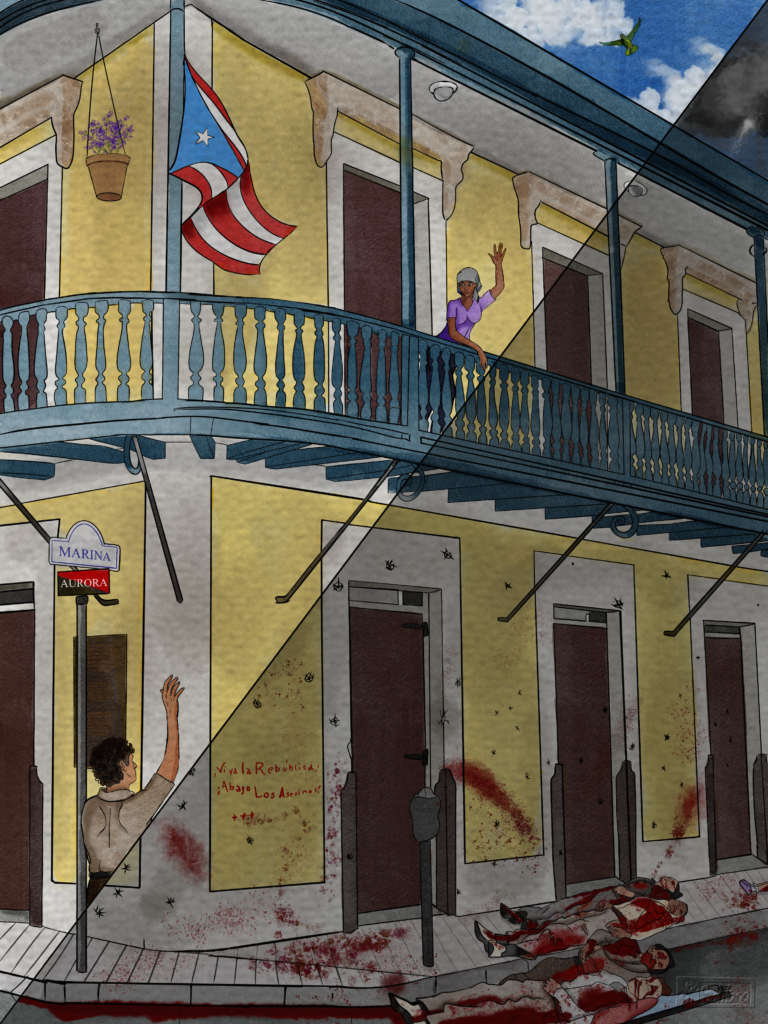
The Cadet that was holding the flag falls dead. A woman ran up and grabbed the flag, and was immediately shot in the chest. Another woman came up, grabbed the flag and this time managed to run away.
The cops wouldn’t let up, as the panic and chaos increased, so did their brutality.
They shot into multiple corpses, over and over again. Stepping over bodies as if they weren’t even there. Bullets flew in every direction, you could hear the sickening sound as they penetrated skin. The police didn’t just stop with bullets, some took out the batons. Jumped over cars and beat onto whoever they could get their hands on.
A seven year old girl ran towards a church and was shot in the back. A man on his way home panicked, shouted “But I am a National Guardsman.” He was promptly shot. Other cops split a vendors head in two as they beat him with a riot club. Another old man was beat to death on his doorstep. An elderly woman was clubbed so badly, brain matter spilled onto the road. Others slipped on it as they ran past. Countless men, women, and children were shot in the back trying to escape the brutality. Many corpses were kicked, checking for signs of life. If any were found, they were shot again point blank range. Ortiz Fuentes, a police officer shot and murdered four men who begged for their lives. Unarmed, with their hands in the air.
The men wielding the Tommy guns kept firing, .45s spurting from a fifty foot range. Civilians dropped like flies as the Tommy guns began to smoke, overheating. The streets and walls of the buildings sprayed with bright red blood. Streams of red connecting as the bodies piled.
Cadet Bolívar Márquez Telechea, as he rasped bleeding out and dying, dragged himself to a wall. He mustered all the strength he had left and using his own blood, he wrote on the cement wall— “Viva la Republica, Abajo los acesinos” which translates to “Long live the Republic. Down with the murderers.” With four crucifixes signed, before he slumped over and took his last breath. The police continued this massacre for thirteen agonizing minutes. By the end of it, nineteen men, one woman, and a seven year old girl lay dead. Well over two hundred were injured. Survivors were groaning, crawling, and begging for mercy. As blood stained the street.
This painting is a memorial to all those that lost their lives, and were affected by the horrible events that occurred on what was supposed to be a peaceful and sacred day. One of the many scars my beautiful island carries,
This isn’t common knowledge unfortunately, even for many people born and raised on the island. The U.S.A propaganda worked so thoroughly it was all but swept under the rug until all the FBI files on Don Pedro and The Nationalist Party were made public. I urge you, to pick up a copy of this book, and read it not just once, but twice. It is important not only for my fellow Borikuas, but for everyone to read. This piece represents the beauty of my island and its people and the brutality we have suffered. The resilience that runs through our veins. Let’s take a moment to remember those lives lost on that fateful day.
- Iván G. Rodriguez Figueras
- Juan Torres Gregory
- Conrado Rivera Lopez
- Georgina Maldonado (seven year old girl)
- Jenaro Rodriguez Mendez
- Luis Jimenez Morales
- Juan Delgado Cotal Nieves
- Juan Santos Ortiz
- Ulpiano Perea
- Juan Antonio Pietrantoni
- Juan Reyes Rivera
- Pedro Juan Rodriguez Rivera
- Obdulio Rosario
- Maria Hernández del Rosario
- Bolivar Márquez Telechea
- Ramon Ortiz Toro
- Teodoro Velez Torres
- Ceferino Loyola Pérez (insular police)
- Eusebio Sánchez Pérez (Insular police)
Unfortunately there are many stories like this and other atrocities that the FBI under Edgar J Hoover committed against the Puerto Rican people. This book covers a great amount in vivid detail. It sites all its sources, and is an incredible source of information and start to a devastating journey on Puerto Rican history.
Thank you for your support. It means the absolute world to me.
You guys are following along and getting a front row seat to my rage and grief. I am processing this the best way I know how and after noticing how much is kept from the public — I hope sharing this knowledge peeks your interest enough to purchase this book.
Until next time!
-Con Mucho amor
Santana